

Grant Fletcher, Senior Health and Science Editor.
You are standing in the shower, staring at three cans you bought because they all promised the same thing: fresher-looking hair without washing it. None of them worked quite the way you expected, and you are not entirely sure why. That question, what is this product actually meant to be doing, is worth answering before you buy another one.
Dry shampoo is one of the simplest products on the shelf and one of the most poorly understood. At its core it is a fine powder, usually a starch or a clay, designed to absorb oil sitting on the scalp and along the hair shaft. Everything else on the label, the fragrance, the tint, the propellant, is secondary to that one job. A 2021 study in the International Journal of Trichology tested absorbent powders on oily scalp samples and found that particle size, not brand positioning, was the strongest predictor of oil uptake after four hours of wear.
This guide walks through what separates a dry shampoo that earns its place in the cabinet from one that sits there half used, based on how people who study hair and scalp actually judge these products.
- Powder chemistry matters more than fragrance: starch and clay particles do the absorbing work, everything else on the label is presentation.
- A short wait changes everything: letting the powder sit for around a minute before brushing out is the step almost everyone skips.
- White cast is often technique, not just formula: spray distance and brushing method explain most residue complaints, not a bad product.
Why The Powder Does The Work, Not The Propellant
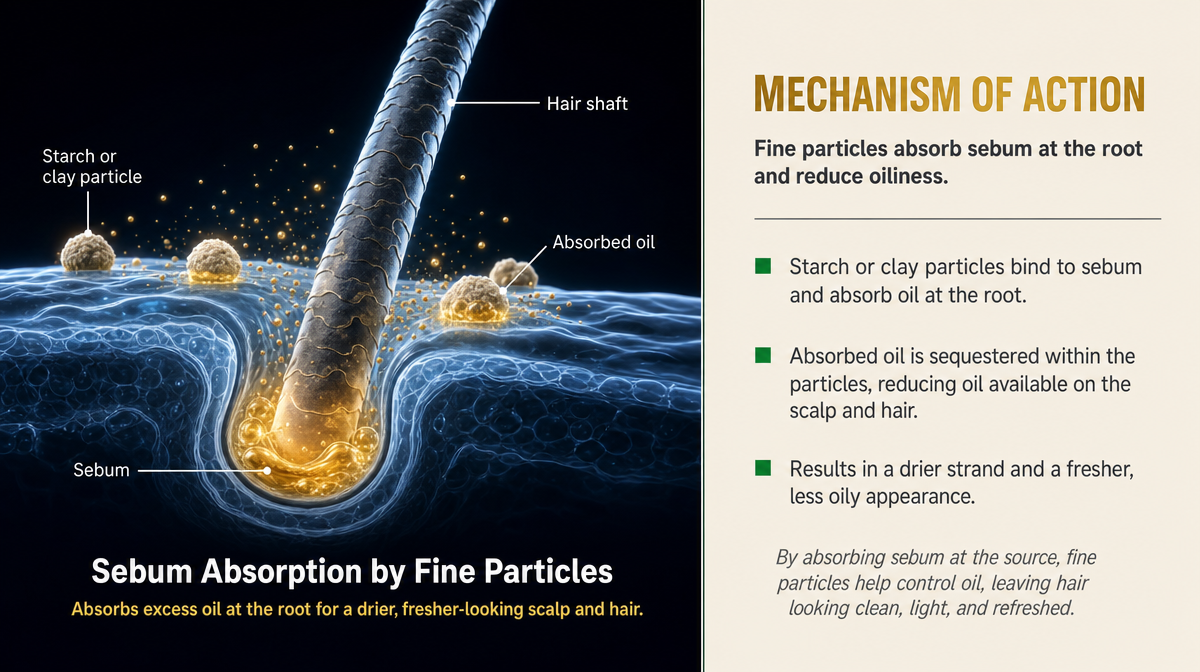
Think of a greasy frying pan and a handful of flour. Sprinkle the flour on and it clumps around the oil, soaking it up so you can wipe the pan cleaner than plain water would manage. Dry shampoo works on the same principle, at a much finer scale, on your scalp.
Most formulas rely on rice starch, tapioca starch, corn starch or a clay such as kaolin. These particles are chosen because they are small enough to sit close to the scalp surface and porous enough to draw sebum, the oil your scalp naturally produces, away from the hair shaft. The propellant in an aerosol can, or the puff mechanism in a powder-only version, exists purely to deliver that powder evenly. It has no absorbing power of its own.
A 2021 study in the International Journal of Trichology compared several absorbent powders under laboratory conditions and found that finer, more porous particles removed visibly more surface oil than coarser ones after four hours, regardless of how the product was packaged or scented. That is the detail worth remembering next time a can promises something dramatic in its marketing copy: the chemistry doing the actual work is usually a few cents’ worth of starch or clay.
Reading The Ingredient List Before The Marketing Copy
Turn the can around before you read the front. The ingredient list, usually printed in tiny type near the barcode, tells you more than any claim on the label.
Look first for the absorbent base: rice starch and tapioca starch tend to feel lighter and less chalky than talc or plain corn starch, particularly on fine hair. Clays such as kaolin or bentonite absorb strongly but can sit heavier, which suits thicker or coarser hair better. Neither type is objectively superior. The right choice depends on your hair’s density and how oily your scalp runs.
Next, check for alcohol denat, sometimes listed as denatured alcohol. It appears in many aerosol formulas to help the product dry quickly and disperse evenly, but it can be drying to scalp skin with repeated use, particularly for people prone to flaking or sensitivity. It is not automatically a problem, but it is worth knowing it is there if your scalp already runs dry.
Fragrance sits last on most lists and matters least to performance, whatever the front label suggests. A product described as having a
The Distance-and-wait Test You Can Do In The Shop

You can learn a surprising amount about a dry shampoo before you ever use it on your own hair, simply by testing the spray pattern.
Hold the can roughly fifteen to twenty centimetres from a dark piece of fabric or the back of your hand and spray briefly. A well-formulated aerosol disperses as a fine, even mist. If it comes out in a wet, concentrated jet, it is more likely to leave damp patches and a heavier residue once it dries on hair. Powder-puff versions should release a light, controllable dusting rather than a clump.
At home, the habit that makes the biggest difference is patience. Once applied, most formulas need thirty seconds to a minute for the powder to fully absorb oil before you brush it through. Brushing immediately just redistributes wet, oily powder rather than removing it. Wait, then brush from roots to ends with a natural-bristle or boar-bristle brush, which lifts residue out rather than pushing it further into the strand.
This single pause, easy to skip when you are in a hurry, is the step most responsible for the difference between a product that looks like it worked and one that visibly did not.
Matching Tone And Avoiding The Grey-white Cast
The white cast that shows up on darker hair is not a flaw unique to cheap formulas. It happens because most absorbent powders are naturally pale, and pale powder sitting on dark strands is visible until it is either tinted or worked in properly.
Tinted formulas add a small amount of pigment, usually a cosmetic-grade colourant, to better match brunette, red or black hair. These help, but they are not a perfect fix: a tint designed for medium brown will still show up lighter on jet black hair, and darker on very light blonde. The safest approach for anyone outside a mid-tone range is to apply less than feels intuitive, work it in thoroughly, and add more only if needed.
Particle size plays a role too. Finer powders tend to disappear into the hair more readily than coarse ones, which is part of why some premium-feeling formulas cost more to produce, even though the underlying starch is similar. If cast is a recurring problem, the fix is rarely a different brand. It is usually a smaller amount, applied further from the scalp part-line, and brushed through for longer than feels necessary.
Application Technique Separates Good Results From Disappointing Ones
Two people using an identical product can get very different results, and the difference usually comes down to technique rather than the formula itself.
Section the hair before spraying, working in layers from the crown outward rather than blasting the whole head at once. Aim the nozzle at the roots specifically, where oil actually accumulates, not along the lengths, which rarely need it and will only pick up unnecessary residue.
The most common mistake is overspraying in one spot because the effect is not immediately visible. Because the powder needs time to absorb oil before it becomes obvious, people tend to add more before the first application has finished working, then end up with a heavier, chalkier result than intended. A lighter first pass, followed by a genuine wait, almost always outperforms one heavy application.
The second common mistake is skipping the brush-out. Fingers alone do not distribute powder evenly or remove the absorbed oil residue the way bristles do. A few minutes with a brush, focused at the scalp, makes a visible difference to how natural the finish looks.
Judging How Long A Result Should Reasonably Last
Expectations matter here as much as the product. Dry shampoo delays the appearance of oily hair, it does not clean hair the way water and shampoo do, and it has a realistic limit on how long it can keep working.
For most people with normally oily scalps, a single application holds up for around one to two days before oil breaks back through the powder layer. Very oily scalps may see that window shrink to less than a day, while drier scalps can stretch it further. These figures line up with general guidance published by dermatology reference resources, which note that sebum production varies significantly between individuals and even day to day for the same person.
Reapplying on top of yesterday’s application, rather than brushing out thoroughly first, is where most people go wrong. Layering powder on top of powder does not extend the effect meaningfully. It mostly adds build-up, which can look dull or slightly grey at the roots and may make the scalp feel tight or itchy. If a single day’s application is not lasting as long as it used to, that is usually a signal to wash properly rather than to spray again.
Reading Your Scalp’s Signals, Not Just Your Hair’s Appearance
Hair can look fine while the scalp underneath is telling a different story. Build-up from repeated dry shampoo use between washes can trap dead skin cells and product residue against the scalp, which some people experience as itching, mild flaking or a feeling of tightness.
DermNet, the dermatology reference founded by New Zealand dermatologists, publishes general guidance noting that scalp irritation can result from a build-up of styling products left on the skin for extended periods, and recommends regular thorough washing to clear residue rather than relying solely on dry cleansing methods. That guidance is worth following literally: dry shampoo is a bridge between washes, not a replacement for them.
A reasonable rule most stylists suggest is to avoid going more than two to three consecutive days on dry shampoo alone before a proper wash, adjusting for your own scalp’s oiliness and sensitivity. If you notice ongoing itchiness, unusual flaking or a scalp that feels sore rather than simply due for a wash, that is a signal to reduce frequency or see a doctor, rather than a signal to try a different can.
Sorting Genuine Formulation Claims From Shelf Marketing
Words like natural, clean and volumising appear on a large share of the dry shampoo shelf, and they mean less than they imply. Natural is not a regulated term in cosmetics, and a plant-derived starch behaves according to its particle size and porosity, not according to how it is marketed.
Volumising claims usually refer to the powder’s texture adding light grip at the roots, which can genuinely make fine hair look fuller for a few hours. That effect is real but modest, and it fades as the powder settles, generally within the same day.
What matters more than any of these claims is the plain mechanical performance covered earlier in this guide: how finely the powder disperses, how much oil it absorbs, how visible it is on your hair colour and how it feels on your particular scalp. Consumer NZ, the independent testing body that has run comparative lab tests on household and personal care products since 1959, has long taken the position in its general reporting that ingredient function and test performance matter more than front-of-pack claims. That is a sound principle to carry into any beauty aisle, dry shampoo included.
Key Takeaways
Dry shampoo works through absorbent powder, not fragrance or packaging, so the ingredient list matters more than the front label.
Give the powder time to work before brushing it out, and brush thoroughly rather than relying on fingers.
Match application to your scalp’s actual oil level and hair colour, and treat dry shampoo as a bridge between washes rather than a substitute for washing.
A Quick Checklist For The Shelf
- Check the ingredient list for rice starch, tapioca starch or a clay such as kaolin near the top.
- Note whether alcohol denat is present if your scalp runs dry or sensitive.
- Test the spray pattern for a fine, even mist rather than a wet jet, where possible.
- Choose a tinted formula if you have medium to dark hair, and apply less than feels intuitive.
- Apply at the roots only, wait around a minute, then brush thoroughly.
- Wash properly every two to three days rather than layering powder indefinitely.
This article is general information and does not replace personalised advice from a dermatologist or hairdresser.
Individual results vary depending on scalp type, hair colour and oil production.