
Aroha Ngata, Staff Writer.
You know the moment. Bathroom mirror, arm raised, checking a shirt before you commit to it. There’s a shelf by the shower with three half-used antiperspirants on it, each bought after the last one “stopped working,” and a nagging feeling that you’re doing something wrong even though you apply it every single morning. Here’s the useful bit most people never get told: antiperspirants need time to bind before you sweat, not a spritz on the way out the door. Get that timing wrong and even a genuinely good formula will underperform, and you’ll blame the product instead of the routine. This guide walks through what’s actually happening under your arm, where routines quietly fall apart, and how to judge whether something is working within a fortnight rather than guessing for months.
- Application timing matters more than formula strength: antiperspirants need roughly six to eight hours undisturbed to form their blocking effect, so night-before application often outperforms a rushed morning swipe.
- Sweat and odour are two different problems: a product can control moisture well and still let odour through, or vice versa, which is why judging “it’s not working” needs a fortnight of honest observation, not one bad day.
- Skin irritation is usually a technique problem, not a skin problem: applying straight after shaving or over broken skin is the most common cause of stinging, and switching formulas rarely fixes it.
What An Antiperspirant Is Actually Doing Under Your Arm
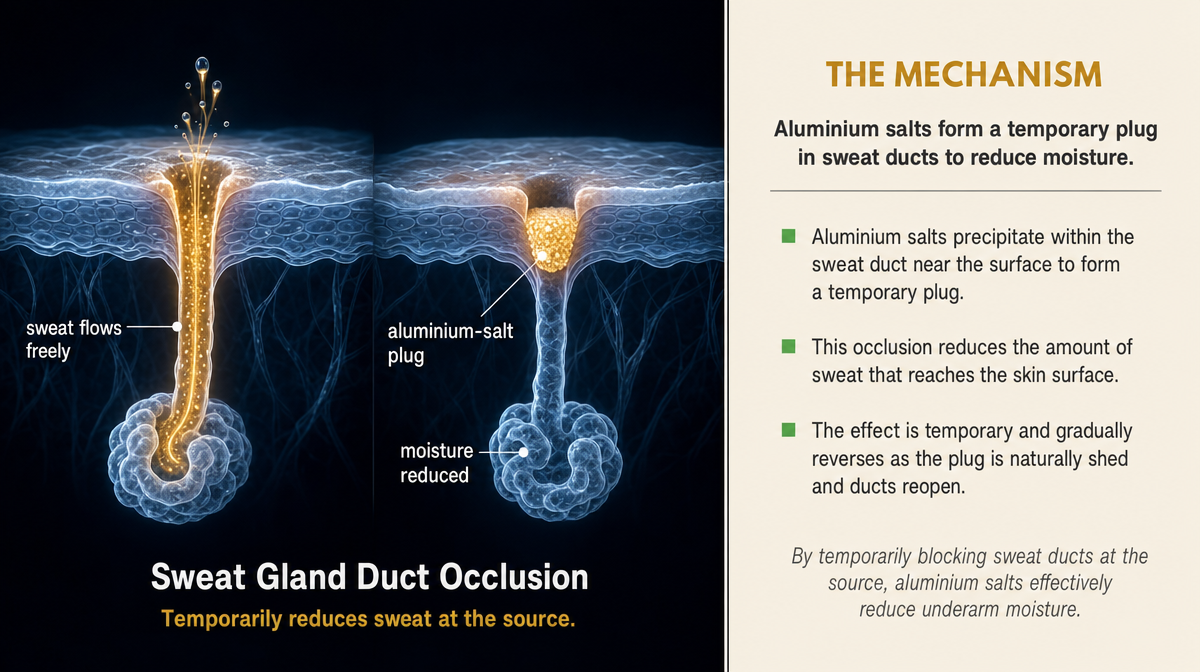
Antiperspirants and deodorants get lumped together, but they solve different problems. A deodorant works on odour: it either masks it with fragrance or reduces the bacteria that feed on sweat and produce the smell. An antiperspirant does something more mechanical. Its active ingredient, usually an aluminium salt, forms a temporary plug near the opening of the sweat duct, which slows the amount of moisture that reaches the skin’s surface.
Think of it like a plumber fitting a temporary washer inside a tap rather than turning the water off at the mains. The tap can still run a little, and the washer needs time to seat properly before it holds back the flow. That’s why an antiperspirant applied and immediately washed off, or applied to already-sweaty skin, never gets the chance to do its job properly.
Dermatology references such as DermNet note that aluminium-based antiperspirants are considered safe for most people when used as directed, and that ongoing research into long-term use has not established the harms once feared in early internet claims. Sensitivity, when it occurs, is far more often linked to fragrance or to application straight after shaving than to the aluminium salt itself.
Applying At Night, Not Just In The Morning
The single biggest routine change that improves antiperspirant performance costs nothing: apply it the night before, to clean, completely dry skin, rather than only in the morning rush.
Sweat glands are less active overnight, which gives the active ingredient several undisturbed hours to settle into the duct before the next day’s demands begin. A morning-only routine means you’re relying on a product to start working the moment you also start moving, showering warmth still on your skin, deodorant only half absorbed by the time you’re out the door.
A simple two-week test: for one week, apply only in the morning as usual. For the second week, apply at night after your shower and skip the morning application entirely, or use a light morning top-up if you prefer the ritual. Note how your shirts fare by mid-afternoon. Most people notice a difference by day four or five of the second week, once the nightly routine has had a chance to compound.
This isn’t about applying more product. It’s about giving the same amount of product the conditions it needs.
Reading A Label Without Falling For Marketing Language
Packaging is designed to be reassuring, which isn’t the same as being informative. “72-hour protection” describes a laboratory testing window under controlled conditions, not a guarantee for a day spent gardening or catching three buses in a heatwave. “Clinical strength” has no fixed regulatory definition in New Zealand; it generally signals a higher concentration of the active aluminium compound, which is worth knowing, but it’s not a certification.
What’s actually worth reading: the active ingredient and its percentage, if listed, and whether the product is labelled antiperspirant, deodorant, or both. Fragrance-free is a genuine, checkable claim. “Natural” is not regulated in the same way and tells you very little about how the product performs.
Consumer NZ has previously published general guidance encouraging shoppers to compare active ingredients and to be sceptical of vague performance claims on personal care packaging, a habit worth applying here as much as to sunscreen or moisturiser.
The honest shortcut: if a label leans hard on adjectives (advanced, ultra, maximum) rather than telling you what’s in it, treat the marketing as separate from the evidence.
Where Irritation Actually Comes From
Stinging or a rash under the arm gets blamed on the antiperspirant almost by reflex, but the timing usually tells a different story. Shaving creates microscopic breaks in the skin’s surface. Applying any active ingredient, fragrance, or alcohol-based product straight after shaving lands it directly into that broken barrier, which is what causes the sting, not necessarily the formula itself.
A useful analogy: it’s the difference between rubbing salt into a graze versus onto intact skin. Same salt, very different result, depending entirely on the state of what’s underneath.
The practical fix is sequencing, not substitution. Shave at night if possible, or at least an hour before applying antiperspirant in the morning. If you shave and dress in under ten minutes, that’s often the entire explanation for recurring irritation, no formula change required.
Genuine allergic contact dermatitis to fragrance or preservatives does happen, and DermNet’s patient information describes patch testing as the reliable way to confirm it rather than guessing through trial and error. If irritation persists despite changing the timing and trying a fragrance-free version, that’s a conversation for a GP or dermatologist rather than another product swap.
Judging Results Honestly Over Two Weeks
One sweaty commute doesn’t mean a routine has failed. Sweat response varies with heat, stress, caffeine, spicy food and hormonal fluctuation, so a fair trial needs a longer window and a bit of record-keeping.
Keep it simple: for fourteen days, note the product used, the time of application, and a rough one-to-five rating of how your underarms felt by 3pm and by bedtime. Include the weather and whether the day was unusually stressful or active. Patterns show up quickly once they’re written down instead of remembered.
A 2019 study published in the British Journal of Dermatology found that perceived antiperspirant efficacy varied significantly with application timing and skin preparation, reinforcing that the same product can perform quite differently depending on the routine around it, not just its formula.
What counts as a fair result: noticeably drier underarms and less visible marking on clothing by the end of the trial, most days, not every single one. If nothing has shifted after two honest weeks of correct application, that’s a genuine signal to look elsewhere, not a personal failing.
Matching The Routine To Your Actual Day, Not An Ideal One
A routine built around an office day with air conditioning won’t necessarily survive a physically active job, a hot commute, or a stage performance. Rather than searching for one product to cover everything, it helps to think in terms of demand levels.
On a genuinely high-output day, applying the night before and adding a light reapplication after a shower or gym session in the late afternoon covers most of the gap left by the day’s activity. On an ordinary day, the nightly routine alone is usually sufficient, and doubling up can increase the chance of irritation without adding much protection, since the duct can only hold so much of the active ingredient at once.
Fabric matters too. Synthetic blends trap moisture and odour differently to cotton or linen, which is part of why the same antiperspirant can feel like it’s “failing” on a polyester-blend workshirt and doing fine on a cotton one. This is a fabric interaction, not necessarily a formula problem.
Beauty coverage in outlets such as Fashion Quarterly and Viva has periodically noted this seasonal mismatch between summer fabrics and personal care routines built in cooler months, worth remembering as the weather turns.
Switching Products Without Starting From Zero
When a change genuinely seems warranted, after a fair two-week trial, switch one variable at a time. Changing the active ingredient concentration, the format (roll-on versus stick versus spray), and the fragrance profile all at once makes it impossible to know which change actually helped.
Formats matter more than people expect. Sprays evaporate quickly and can leave less product in contact with the skin long enough to be absorbed into the duct, which is one reason some people find sticks or roll-ons more reliable for all-day control, even though sprays feel more pleasant to apply.
Give any new product the same fourteen-day, night-application trial described earlier rather than judging it on day one. Skin, and its resident bacteria, take time to adjust to a new formula, and first impressions during that adjustment window are notoriously unreliable.
A Quick Self-test Before You Buy Anything New
Before reaching for a different product, run through three questions honestly. Am I applying at night, on completely dry skin, and giving it several hours before I sweat? Am I applying straight after shaving, or leaving at least an hour’s gap? Have I actually tracked two full weeks, or am I judging off one hot Tuesday?
If the answer to any of those is no, the routine hasn’t been properly tested yet, regardless of which product sits on the shelf. New Zealand Woman’s Weekly and Ensemble have both run reader Q&A columns over the years fielding almost identical questions, which suggests this is a far more common gap than a formula problem.
Only once timing, sequencing and a genuine trial period are all accounted for is it worth concluding that a product itself is the limiting factor.
Key Takeaways
Antiperspirants need hours of undisturbed contact to work, which is why night-time application on dry skin generally outperforms a rushed morning swipe. Irritation is more often caused by shaving too close to application than by the formula itself. Judge any routine or product change over a full fortnight with basic notes, not a single unusually hot or stressful day, and treat marketing language on packaging as separate from the actual active ingredient list.
A Simple Checklist
- Shower and dry underarms completely before applying, ideally at night
- Leave at least an hour between shaving and application
- Check the label for the active ingredient and percentage, not just the marketing phrase
- Track mornings and evenings for two full weeks before judging a product
- Match reapplication to genuinely high-output days rather than doubling up daily
- See a GP or dermatologist if irritation persists despite correct timing and a fragrance-free trial
This article is general information and does not replace individual medical advice.
Individual results vary; consult a GP or dermatologist for persistent skin concerns.