
Holly Anderson, Beauty Editor.
You know the shelf. Three half-used mists lined up by the mirror, each one promising to lock your makeup in place for a day that, in reality, involves wind off the harbour, a stuffy office, and a flat white steaming up your face at 3pm. You spray, you wait, and somewhere around lunchtime your foundation has migrated anyway. So you stand there asking the question so many New Zealanders quietly type into their phones: which setting spray actually works, and how would you even tell before you have bought the thing and used it for a fortnight?
Here is a fact that changes how you shop: setting spray performance has almost nothing to do with scent, packaging, or how fine the mist feels on your skin. It comes down to a small list of film-forming ingredients and how they interact with the particular combination of oils, sweat, and foundation already sitting on your face. Once you know what to look for, you can judge a bottle in the aisle, or from an online listing, in under a minute.
This guide walks through exactly what dermatologists and formulation scientists actually check first, broken into plain steps you can use yourself.
- Longevity comes from film formers, not fragrance: ingredients like acrylates copolymers or PVP form an invisible flexible layer; a spray that lists mostly water and floral extracts is cosmetic, not a setting product.
- Your skin type decides the finish that will last: oily skin needs a mattifying, oil-absorbing formula while dry skin needs humectants, or the spray that worked for your sister will fail on you by 11am.
- A 30-second patch test on your jaw tells you more than any review: wait, touch, and watch for pilling or tackiness before you commit a whole face to a new bottle.
What A Setting Spray Is Actually Doing To Your Face
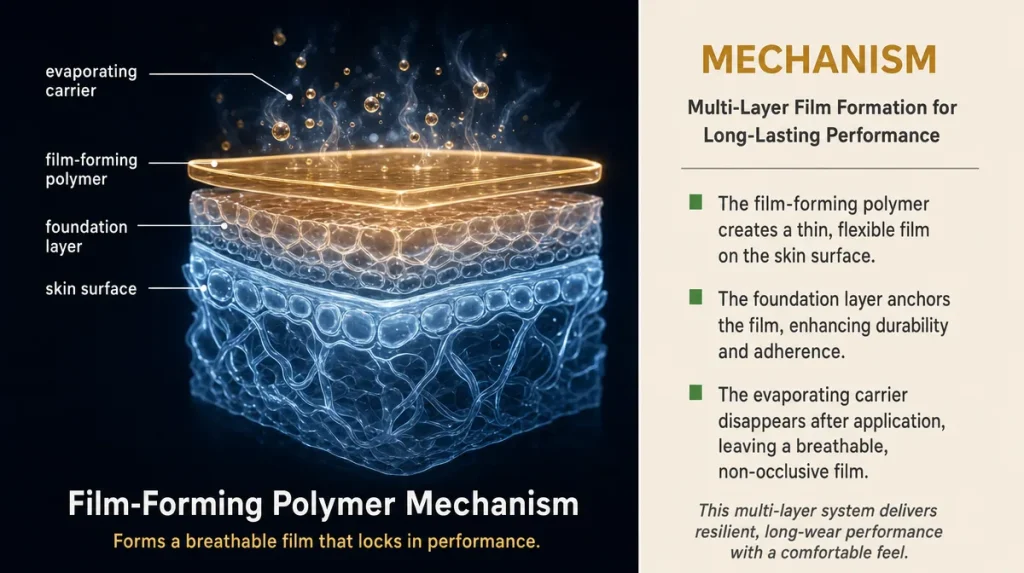
Think of a setting spray the way you think of the clear varnish a joiner brushes over a finished table. The varnish is not the timber and it is not the stain, it is a thin, flexible layer that sits on top and stops everything underneath from smudging, lifting, or rubbing away. A setting spray does the same job over your foundation, concealer, and powder.
The active work is done by what chemists call film-forming agents. Common ones include acrylates copolymer, PVP (polyvinylpyrrolidone), and various silicone derivatives. These molecules dissolve in the spray’s liquid carrier, then as the carrier evaporates off your skin, they knit together into a thin, breathable film.
A study in the Journal of Cosmetic Science in 2021 measured how different film-forming polymers affected makeup transfer onto fabric over an eight-hour wear period, and found that formulas with a higher proportion of film-forming polymer resisted transfer markedly better than water-based mists with mostly botanical extracts and fragrance.
This matters because most of the marketing language on a bottle, dewy, matte, weightless, is describing the sensory experience, not the mechanism. Two sprays can feel almost identical misting onto your hand and perform completely differently over a ten-hour day, because one has real film-forming chemistry and the other is essentially scented water with a thickener.
Reading The Ingredient List In Under A Minute
You do not need a chemistry degree to read a setting spray label well, you need to know what to scan for and in what order.
First, look near the top third of the ingredient list for any of these: acrylates/acrylamide copolymer, PVP, VP/VA copolymer, or a dimethicone variant. Ingredients are listed by concentration, so if a film former appears in the first five entries, the formula is likely built for genuine hold.
Second, check for humectants such as glycerin, sodium hyaluronate, or panthenol. These do not fix makeup in place, but they keep the film flexible rather than brittle, which matters if your skin tends dry or if you live somewhere with low humidity for parts of the year.
Third, note the carrier. A high-alcohol carrier (often listed as alcohol denat.) evaporates fast and can feel refreshing, but may be drying with repeated daily use, particularly over winter. A water-based carrier with added glycols tends to feel gentler but can take slightly longer to set.
The mistake most buyers make is scanning for words like ‘dermatologist-developed’ or ‘all day’ printed on the front label and stopping there. Front-of-pack claims are marketing copy and are not required to reflect the formula underneath in any specific way. The ingredient list, by contrast, is a legal document. It is the one part of the packaging that cannot lie to you.
Matching The Formula To Your Actual Skin, Not Your Friend’s
A spray that performed beautifully for a colleague with oily, acne-prone skin can feel tight and flaky on drier skin by mid-afternoon, and this is not inconsistency in the product, it is physiology.
Oily skin produces more sebum throughout the day, and sebum is a solvent: it can soften and break down a thin polymer film faster than normal. For oilier skin types, formulas containing silica or kaolin-derived mattifying agents alongside the film former tend to hold up better, because they are absorbing the oil that would otherwise dissolve the setting layer.
Dry skin has the opposite problem. A film former without enough humectant support can sit on already-dehydrated skin and emphasise fine lines or flaking, particularly around the nose and chin by evening. Here, a formula listing glycerin or hyaluronic acid derivatives higher in the ingredient list tends to behave better over a full day.
Combination skin, common across New Zealand’s variable climate, often does best with a formula that is not heavily weighted to either extreme, something with a moderate film former and a light humectant, rather than a product marketed specifically as ‘oil control’ or ‘glow’.
A simple self-test: apply your regular makeup routine on two separate days, using a different setting spray each day, and photograph your T-zone at midday both times under the same lighting, such as near a window at work. Over two or three comparisons like this you will see a genuine pattern rather than guessing from a single good or bad day.
The Jaw Patch Test, And Why Most People Skip It
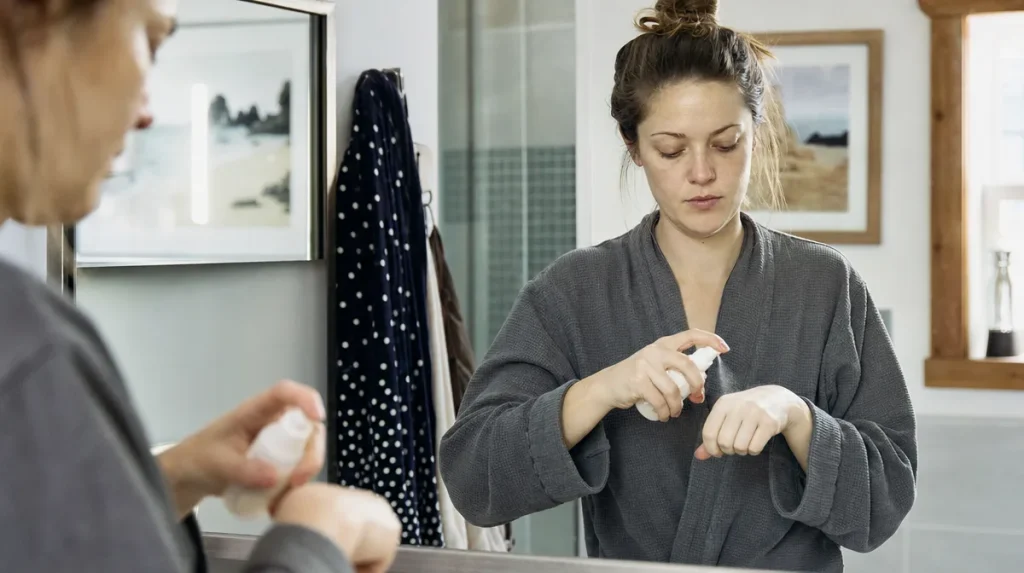
Before committing a full face of makeup to a spray you have not used, mist a small amount onto clean skin along your jawline or the inside of your wrist and let it dry fully, which usually takes somewhere between 20 and 45 seconds depending on the formula.
Then touch the area lightly. A well-behaved film should feel smooth and slightly tacky for a moment before settling into a dry, flexible finish. If it stays sticky for much longer than a minute, or if it beads up and rolls off in little grey rolls when you rub it gently, that is called pilling, and it usually signals the film former is incompatible with whatever moisturiser, sunscreen, or primer is already on your skin.
Pilling is one of the most common complaints with setting sprays and it is rarely the fault of the spray alone. It typically happens when silicone-based primers underneath meet a water-based spray on top, or vice versa, and the two layers do not bond. Dermatologists sometimes describe this as a ‘layering conflict’ rather than a faulty product.
Most people skip this test because it feels like an extra step before a rushed morning, but it takes well under a minute and can save an entire makeup application from needing to be redone at 8am. It is worth doing with any new spray, even one a friend has recommended, because her skincare layers underneath are not yours.
What “All Day Wear” Claims Actually Mean, And What They Do Not
Phrases like ’16-hour wear’ or ‘all day hold’ printed on a bottle usually refer to results from an internal or commissioned wear study, often conducted under controlled conditions: a set room temperature, moderate humidity, and a panel of participants who did not exercise, eat greasy food, or spend time outdoors in wind or heat during the test window.
That is a legitimate way to measure a formula’s baseline performance, but it is not your Tuesday. A spray tested to hold for 16 hours in an air-conditioned lab may perform quite differently across a day that includes a humid bus commute, a hot office, and an afternoon coffee catch-up outdoors.
DermNet, the clinical reference founded by New Zealand dermatologists, notes in its general skincare guidance that environmental factors such as heat, humidity, and sebum production meaningfully affect how topical products behave over the course of a day, which is a useful reminder that wear-time claims are a starting point rather than a guarantee.
The more useful question to ask yourself is not ‘how many hours does this claim’ but ‘what conditions was this likely tested under, and how close are those to my actual day’. A spray marketed for brides and tested for an eight-hour indoor reception may not be the right choice for someone working outdoors or commuting by bike.
Matte Versus Dewy: A Finish Choice, Not A Performance Difference
One of the more persistent pieces of marketing confusion is the idea that a matte-finish setting spray automatically lasts longer than a dewy or luminous one. In most formulas, the finish is governed by different ingredients than the ones responsible for hold.
Matte finishes typically rely on silica, talc, or other light-diffusing powders suspended in the formula, which scatter light and reduce visible shine. Dewy finishes often use small amounts of glycerin or light esters that reflect light more directly, giving a fresher look. Neither of these additions is the film former doing the actual work of fixing makeup in place.
It is entirely possible to buy a matte spray with a weak film former that fades by early afternoon, and a dewy spray with a strong one that holds through a long evening. Choosing based on finish alone, which is how most people shop, tells you nothing reliable about longevity.
If long wear matters more to you than finish, read past the front-of-pack words ‘matte’ or ‘dewy’ and go back to checking where the film-forming ingredient sits in the list, as covered earlier in this guide. Finish is a cosmetic decision. Hold is a chemistry decision. They are not the same choice.
Storing And Using Your Spray So It Performs As Intended
Even a well-formulated setting spray can underperform if it is stored or applied poorly, and this is one area almost entirely within your control.
Keep the bottle out of direct sun and away from the bathroom windowsill, since UV exposure and heat fluctuation can gradually destabilise some film-forming polymers and humectants over months of storage. A cool drawer or cupboard is a better home for it than a sunny ledge.
When applying, hold the bottle at least 20 to 30 centimetres from your face. Spraying too close concentrates product unevenly and can cause pooling, which disrupts the thin, even film the polymer needs to form properly. A light, even pass in an X or T shape across the face, followed by a few seconds of letting it air dry rather than patting it in, generally gives the most consistent result.
Avoid touching your face immediately after application, including the common habit of blotting with a tissue. The film needs a short window, often under a minute, to set properly, and interrupting that process is one of the quieter reasons a spray that tested well at the counter underperforms once at home.
Key Takeaways
Setting spray performance is decided by film-forming ingredients, not scent or sensory feel on application.
Match the formula type to your actual skin type and the conditions of your day, not to what worked for someone else.
A 30-second patch test before full application catches pilling and compatibility issues before they cost you a whole face of makeup.
Wear-time claims on packaging reflect controlled test conditions, not your specific commute, climate, or activity level.
Finish (matte or dewy) and longevity are governed by different ingredients, so choosing by finish alone tells you little about hold.
A Quick Checklist Before You Buy
- Check the first five ingredients for a film former such as acrylates copolymer, PVP, or a dimethicone
- Look for a humectant like glycerin if your skin runs dry, or a mattifying agent like silica if it runs oily
- Patch test on your jaw or wrist and wait a full minute before judging the finish
- Consider what conditions the product was likely tested under versus your actual day
- Store the bottle away from direct sun and heat
- Apply from 20 to 30 centimetres away and let it air dry without touching your face
This article is general information and does not replace individual advice from a dermatologist or pharmacist.
Individual skin response varies, and results described in cited studies may not reflect every person’s experience.