

Simon Kelly, Staff Writer.
Most people meet the question somewhere near the bathroom mirror, late at night, scrolling past another brush promising to ‘unclog pores in seconds’. The shelf behind them already holds two half-used cleansers, a flannel gone grey at the edges, and the plastic case of a brush bought eighteen months ago and used four times. The question she actually types into the search bar isn’t ‘which brush is best’. It’s closer to: does this thing actually do anything, or am I just scrubbing my face with an expensive toothbrush.
That’s a fair question. A facial cleansing brush is a mechanical tool, not a formula, so its effect depends almost entirely on bristle design, technique, and frequency. Get those right and a brush can lift away makeup residue and loosened dead skin more thoroughly than fingers alone, according to a 2019 study in the International Journal of Cosmetic Science that compared manual and device-assisted cleansing over four weeks. Get them wrong, and it can leave skin tighter, redder and more reactive than before you started.
- Bristle softness and technique matter more than motor strength or price: a gentle, slow brush used correctly will outperform a powerful one used too often or pressed too hard.
- Most skin needs a brush two to three times a week, not daily: daily use on the same patch of skin is the most common cause of complaints about redness and tightness.
- A brush only moves product and debris, it cannot replace what’s in the cleanser: the formula underneath still does the actual work of removing oil, makeup and sunscreen.
Why A Spinning Brush Feels Different Under Your Hands
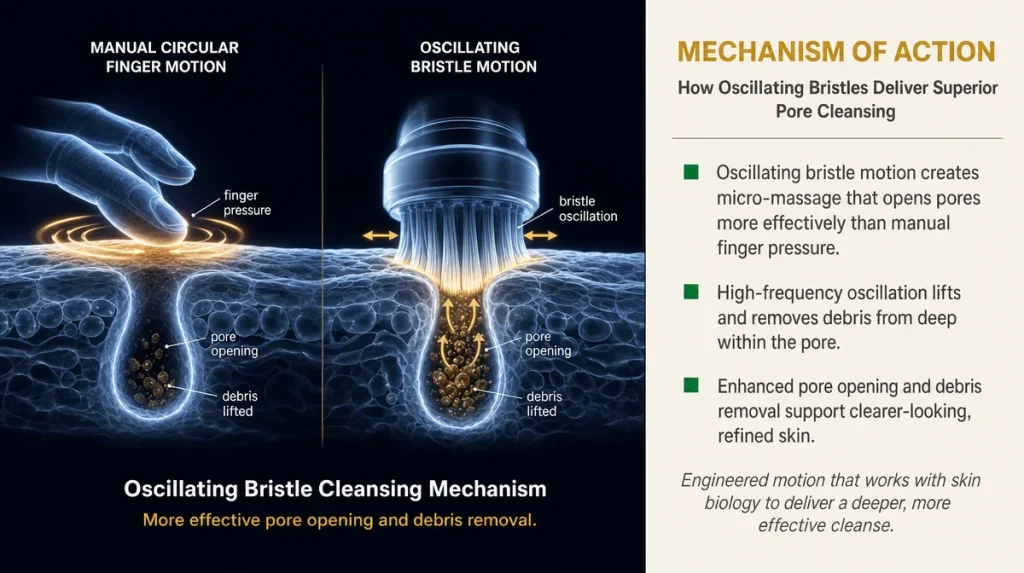
Fingers clean skin by pushing cleanser around in loose circles, relying on soap chemistry to do most of the work. A mechanical brush adds repeated, even contact: bristles flex against the skin surface tens or hundreds of times a second, depending on the mechanism, physically dislodging debris sitting in pore openings rather than just moving liquid over the top.
Think of it the way a soft-bristled dish brush outperforms a bare hand on a baking tray with stuck-on residue, not because the brush is stronger, but because it reaches into the texture of the surface more consistently than fingertips can. The skin equivalent of that stuck-on residue is a mix of sebum, sunscreen, and makeup that settles into pore openings over the course of a day.
A 2019 study in the International Journal of Cosmetic Science, running a four-week trial with 42 adult participants, found device-assisted cleansing removed visibly more makeup and surface oil than manual washing with the same cleanser, measured by sebum metering and standardised photography. The gain was modest, not dramatic, and it came with a caveat the researchers were careful to note: more thorough cleansing is only better if the skin barrier tolerates the extra mechanical contact.
Matching Bristle Density To Your Skin Type
Not all bristles are equal, and the difference is one you can feel with your fingertip before you ever touch your face. Press the bristle head gently against the inside of your wrist. If it feels springy and barely registers, it’s soft enough for most skin. If it feels scratchy or leaves a faint pink mark after a few seconds, it’s firmer than it should be for daily facial use.
Skin that is oily, thick, or prone to congestion around the nose and chin generally tolerates a slightly firmer bristle, used briefly, because there is more surface debris to shift. Skin that is dry, thin, or prone to redness does better with the softest bristle available, used for less time and less often.
DermNet, the dermatology reference founded by New Zealand specialists, groups rosacea-prone and eczema-prone skin among those generally advised to avoid physical exfoliation tools, since mechanical friction can aggravate an already compromised barrier. That guidance is worth taking seriously before buying anything with bristles at all, brush or otherwise.
Self-test: run the bristle head lightly over the back of your hand for ten seconds. If it feels pleasant, it is probably fine for your cheeks. If it feels like anything close to scrubbing, it is too firm for the thinner skin around your eyes and jawline, even if it suits your nose.
Sonic Vibration Versus Rotating Heads: What The Difference Actually Does

Two mechanisms dominate the category. Sonic brushes vibrate at high frequency without the bristle head actually spinning, while rotating brushes turn in a continuous circle, sometimes alternating direction. Marketing copy treats the difference as a hierarchy, with higher numbers framed as better. The research doesn’t support that framing cleanly.
A 2021 comparison published in the Journal of Cosmetic Science, using 30 participants over two weeks, found no statistically meaningful difference in measured skin clarity between sonic and rotating devices when bristle softness and session length were held constant. What did correlate with better outcomes, and fewer reports of irritation, was shorter contact time per area: roughly ten to fifteen seconds per zone rather than a full minute of circling the same patch of cheek.
In practical terms, vibration frequency and rotation speed are closer to marketing differentiators than clinically meaningful variables, provided the bristle itself is soft and the user isn’t lingering in one spot. The motor matters less than most packaging suggests.
The Pressure Mistake Almost Everyone Makes
Ask anyone who has used a cleansing brush for a few months what went wrong, and pressure is usually the answer, even when they don’t realise it. The instinct with any cleaning tool is to push harder for a cleaner result. On skin, that instinct backfires.
The bristle tips, not the pressure behind them, do the physical work of lifting debris. Pressing the head firmly into the skin flattens the bristles against the surface, reducing the flexing motion that actually does the cleaning while increasing friction against live tissue. The result is skin that feels stripped rather than clean: tight, sometimes blotchy, occasionally stinging when a toner or serum goes on afterwards.
The fix is almost embarrassingly simple. Let the device’s own weight do the work. Hold it the way you’d hold a paintbrush rather than a scrub brush, guiding it across the skin rather than driving it into the surface. If your arm feels like it’s working, you are pressing too hard.
Overuse compounds the problem. A brush used morning and night on the same skin rarely gets a chance to recover its natural oil balance between sessions, which is why most dermatology guidance, including general advice published by DermNet, points toward two to three sessions a week for most adult skin rather than daily use.
What A Realistic Timeline For Results Looks Like
Skin texture changes on a biological clock, not a marketing one. Surface skin cells take roughly three to four weeks to turn over fully in healthy adult skin, a figure widely cited in dermatology literature and reflected in general guidance from DermNet. A brush cannot shorten that cycle, it can only help remove the debris sitting on top of it more evenly.
Most people who notice a genuine difference in texture or clarity report it somewhere between two and six weeks of consistent, correctly paced use, not after a single session. Redness or improved product absorption noticed the same evening is usually a sign of temporarily increased blood flow and nothing more, not a lasting change.
Judging results fairly means comparing like with like: same lighting, same time of day, ideally a photo taken under a window rather than overhead bathroom lighting, which flattens texture and hides the very changes you’re trying to track. Checking weekly rather than daily avoids mistaking normal day-to-day variation for progress or setback.
Reading The Marketing Claims: What’s Backed And What Isn’t
Packaging language in this category leans heavily on phrases that sound clinical without meaning much. ‘Deep pore cleansing’ has no fixed clinical definition; pores don’t have a measurable depth that a brush can be shown to reach. ‘Clinically proven’ often refers to a single small in-house trial, sometimes unpublished, rather than independent peer-reviewed research.
Beauty pages in New Zealand Woman’s Weekly have for decades reminded readers that a device’s claims are only as good as the evidence behind them, a habit worth borrowing when reading any packaging in this category. The claims worth trusting are specific and measurable: a stated vibration frequency, a named bristle material, a battery life in hours. The claims worth treating with scepticism are vague and emotional: ‘transform’, ‘radiant’, ‘flawless’.
One genuinely useful filter: if a claim could apply equally to any brush on the shelf, it’s marketing language rather than a meaningful differentiator. If it describes something you could verify yourself with a timer or a bristle press-test, it’s probably real.
Keeping A Brush Clean Enough To Use On Your Face
A bristle head sitting damp in a steamy bathroom is a small, repeatedly reused surface pressed against the face, which makes hygiene a genuine factor rather than an afterthought. Consumer NZ, the non-profit that has independently lab-tested household products since 1959, has noted in broader product-safety guidance that damp tools left in humid bathrooms can accumulate bacteria within days, a general caution worth applying here.
Rinsing the bristle head thoroughly after each use and standing it upright to air-dry, rather than storing it head-down in a closed case, reduces the moisture that bacteria need to multiply. Most manufacturers recommend replacing bristle heads every three months with regular use, which lines up with how quickly nylon bristles lose their flex and begin to fray at the tips, reducing the gentle flexing action that makes the brush useful in the first place.
A simple check: if the bristles look splayed outward rather than standing upright, or feel noticeably stiffer than when new, it’s past its useful life regardless of how long you’ve technically owned it.
A Two-minute Self-test Before You Buy Or Keep Using One
Before buying, or before deciding whether to keep using one already in the bathroom cabinet, run this quick check. Press the bristle head against the inside of your wrist for five seconds. Comfortable pressure that leaves no mark means the bristle is soft enough for facial skin. Any scratchiness or lingering pink mark means it belongs on a body brush shelf, not a cheek.
Next, time an actual cleanse. Thirty seconds total, moved gently across the face, is enough for most skin according to the contact-time findings discussed earlier. If a full session with a given device naturally runs past a minute before you feel ‘clean’, the bristle is likely too soft to be doing much work, or you’re pressing too lightly to matter.
Finally, check in the mirror an hour afterwards, not immediately. Skin that still looks slightly flushed or feels tight an hour later is telling you something a brand’s packaging never will.
Key Takeaways
A facial cleansing brush is a mechanical aid, not a formula, and its value depends on bristle softness, gentle pressure, and restraint on frequency rather than motor strength or price. Two to three sessions a week, thirty seconds each, with a soft bristle and light pressure, covers what the evidence actually supports for most adult skin. Marketing terms like ‘deep pore cleansing’ describe a feeling rather than a measurable effect, while specific, verifiable details such as bristle material and vibration frequency are worth paying attention to.
A Practical Checklist
- Press the bristle head against your wrist: no sting, no mark, means it’s soft enough for your face.
- Limit sessions to two or three times a week, thirty seconds per session, unless your skin clearly tolerates more.
- Let the device’s weight do the work; guide it, don’t push it.
- Rinse and air-dry the bristle head upright after every use.
- Replace the bristle head roughly every three months, or sooner if it looks splayed or feels stiff.
- Judge results after two to six weeks, in consistent lighting, not after a single session.
- Treat vague claims (‘radiant’, ‘transform’) with scepticism; trust specific, checkable details instead.
This article is general information and does not replace advice from a dermatologist or other qualified health professional.
Individual skin responses vary, and results described here may not apply to everyone.