
Holly Anderson, Beauty Editor.
You are leaning into the bathroom mirror at 7am, colouring in a lip line before the school run or the first video call of the day, and you already know how it ends: a faint stain by morning tea, a smudge on the coffee cup, a photo where the lipstick has migrated everywhere except onto your lips. Somewhere in a bathroom drawer sits a small graveyard of lipsticks bought on a “transfer-proof, 24-hour wear” promise that did not survive breakfast.
This guide will not tell you which lipstick to buy. It will tell you why lipstick actually stays put, or does not, so you can read a label, or judge a formula in your own hand, without letting marketing copy do the thinking for you.
One fact worth knowing before anything else: most “long-wear” claims are tested under conditions far gentler than an actual day of eating, drinking and talking. A 2021 study in the International Journal of Cosmetic Science found a marked gap between laboratory transfer tests and real-world wear, based on diaries kept by 64 women over eight hours of ordinary activity.
- Wear time is decided by chemistry, not price: a cheap polymer-based formula can outlast an expensive cream one, and vice versa, depending on how the pigment is suspended.
- Every finish trades comfort against longevity: matte formulas typically wear longest but can highlight dry patches, while creamy finishes feel better but fade sooner.
- Preparation and technique add hours of wear for free: exfoliation, a thin balm base and a blot-and-layer method can outperform switching to a pricier lipstick entirely.
Why Lipstick Disappears Faster On Some Lips Than Others
Lips have no oil glands of their own. Unlike the surrounding skin, they rely on saliva and nearby tissue for moisture, which means the surface is more porous and more mobile than most people assume.
Think of it like painting a damp fence. Paint applied to a dry, sealed surface grips and cures. Paint applied to something still slightly wet slides, thins and rubs off onto whatever touches it next, a sleeve, a cup, a mask.
That is roughly what happens with lipstick and saliva. Every time lips part to speak or moisten themselves out of habit, some pigment lifts with the moisture. The more naturally hydrated or textured the lip, the faster this exchange happens.
This is also why the same lipstick can behave completely differently on two people. Dr researchers studying lip physiology have noted that individual variation in saliva production and lip surface texture is a bigger factor in perceived wear time than the formula itself in many cases.
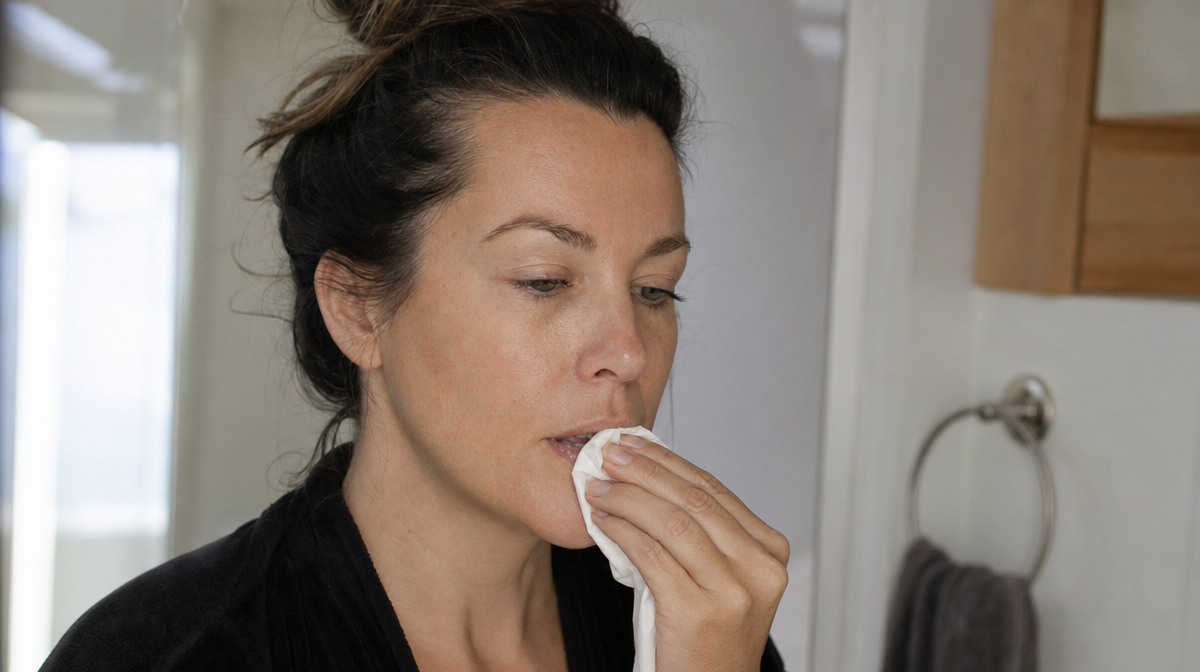
A simple fix costs nothing: blotting lips with a dry tissue immediately after application removes the excess moisture layer the pigment would otherwise slide on, before it has a chance to transfer anywhere.
The Chemistry Behind ‘Transfer-resistant’ Formulas
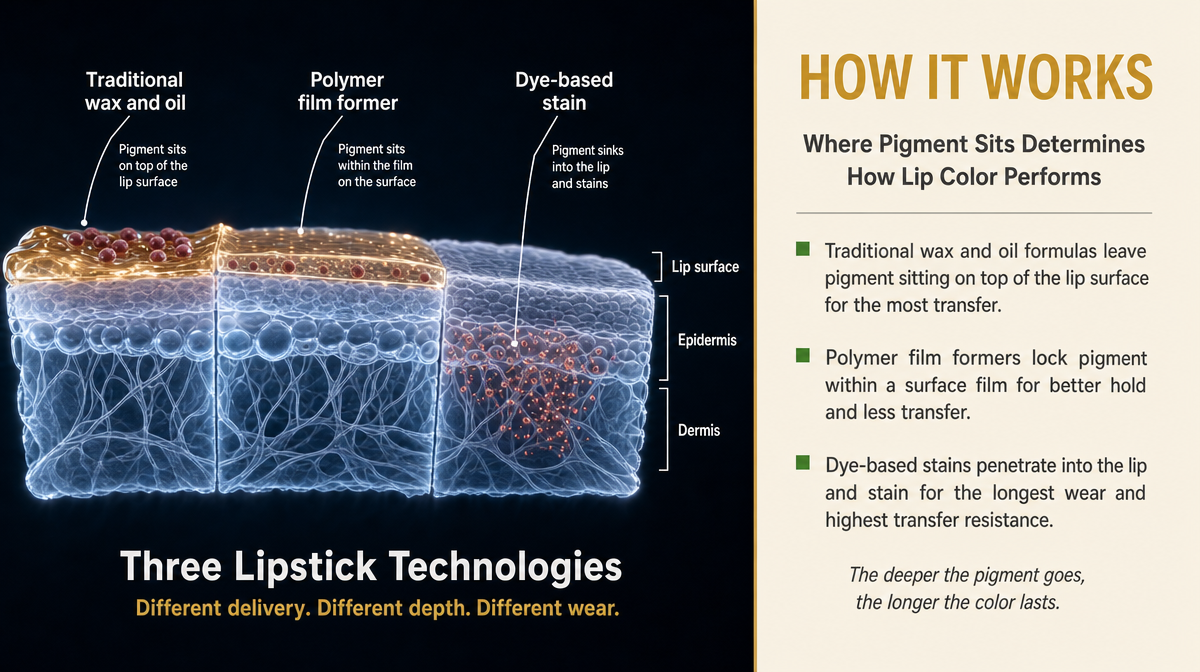
Traditional cream lipsticks sit on top of the lip in a wax and oil base. They feel comfortable because oil keeps migrating and softening the film, but that same oil is what lets pigment transfer onto glasses and collars.
Long-wear formulas usually swap much of that oil for volatile silicones or film-forming polymers. These evaporate after application, leaving behind a thin, flexible plastic-like layer with pigment locked inside it, similar in principle to how a thin coat of clear nail polish dries into a hard film rather than staying liquid.
A 2019 formulation review in the Journal of Cosmetic Science described this film-forming approach as the dominant mechanism behind most modern long-wear lip products, distinguishing it from older stain-based technology that relies on dye binding directly to the lip’s own pigment rather than sitting on the surface at all.
Knowing which mechanism you are dealing with explains a lot. A polymer film can crack or flake on very dry lips because it has no give. A dye-based stain will not rub off easily but can look patchy if applied unevenly, because it is reacting with the lip rather than coating it.
Matte, Satin, Stain: What The Finish Actually Trades Off
Finish is not just a look, it is a fairly reliable clue to wear time and comfort.
Matte formulas typically carry a higher concentration of pigment and less oil, which is what gives the flat, velvety appearance. Less oil means less migration, so mattes generally last longer through eating and drinking. The trade-off is that they can settle into dry patches or fine lines, because there is little emollient left to smooth over texture.
Satin and cream finishes contain more oils and emollients, which feel noticeably softer on application and glide over rough patches more forgivingly. They also fade faster, because that same oil content encourages transfer.
Stains and dye-based tints sit closer to the lip’s own tissue rather than on top of it. They resist rubbing off almost entirely, since there is no surface film to lift, but the colour they produce depends partly on the wearer’s own lip pigment, so results vary more from person to person than with pigmented formulas.
None of these is objectively better. A dry-lipped reader chasing an eight-hour matte will likely be disappointed regardless of brand, while someone with naturally soft, well-hydrated lips might get long wear from a satin finish that would flake on someone else within the hour.
The Application Method That Adds Hours
Technique changes wear time more than most people expect, often more than switching lipsticks entirely.
Start with a light exfoliation, even just a soft toothbrush worked gently over dry lips, followed by a thin layer of balm left to absorb for a minute before blotting off the excess. Applying lipstick directly onto rough, flaking skin gives the pigment nothing even to grip.
Line lips just inside the natural border with a matching pencil before filling in with colour. This does two things: it gives the pigment a slightly drier surface to bond to at the edges, which is usually where fading shows first, and it creates a subtle barrier that slows outward feathering.
The blot-powder-blot method, applying lipstick, blotting with tissue, dusting a whisper of translucent powder through the tissue onto the lips, then applying a second thin coat, is a technique long used backstage by makeup artists and it works on the same principle as setting foundation: the powder absorbs surface oil so the second layer has less to slide on.
Applying lipstick in one thick coat rather than two thin ones is one of the most common mistakes. A thick single layer takes longer to set and is more prone to cracking or smudging before it cures.
Mistakes That Quietly Shorten Wear Time
A few habits undo even a well-formulated long-wear lipstick.
Applying a heavy balm immediately beforehand and not blotting it off is one of the most common. The oil sits between the lip and the pigment, and no polymer film can grip through a layer of slippery emollient.
Eating oily or acidic food in the first half hour after application is another. Fats in food can soften a polymer film before it has fully set, and citrus acidity can degrade certain dye-based pigments.
Habitual licking or pressing lips together to “blend” also removes far more product than most people realise, since it reintroduces moisture exactly where the formula needs to stay dry.
Finally, storing lipstick in a hot car or bathroom cabinet with fluctuating temperature can soften wax-based formulas over time, changing how they set on application even before the tube is opened for the day. This will not show up on a swatch test in-store, only after weeks of ownership.
How To Run Your Own Wear Test
Rather than trusting a packaging claim, it is straightforward to test a lipstick’s real wear time at home.
Apply it as you normally would, note the time, and go about an ordinary day rather than sitting still. At the two, four and six hour marks, take a quick photo in the same lighting, ideally near a window. Eat one normal meal and drink from an open cup at least once during the test, since these are the two activities that most affect wear.
Look specifically at where the colour fades first. Fading from the centre outward usually points to a formula that is too oily or emollient for your lip’s natural moisture level. Fading from the outer edge inward, leaving a darker ring, often means the liner or edge definition wore off before the centre did, which is a sign the product might benefit from a thinner application at the border.
A formula that survives six hours with even, gradual fading rather than patchy loss is doing its job. One that looks perfect at zero hours and patchy by hour two is very likely reacting badly with your specific lip chemistry rather than being poorly made in general terms.
Marketing Language Versus What The Mechanism Can Prove
Claims like “24-hour wear” or “waterproof” are usually based on standardised laboratory rub tests, where a fixed pressure is applied a set number of times under controlled humidity, not a day of eating, talking and drinking coffee.
Consumer NZ has, in its general guidance on reading cosmetic and household product claims, noted that laboratory performance claims often describe best-case conditions rather than typical use, a pattern worth keeping in mind for lip products specifically, since a rub test cannot replicate saliva exposure or food contact.
“Waterproof” tends to mean genuinely resistant to plain water, which is a fair claim to test and largely true. “Transfer-resistant” is a softer term and usually means reduced transfer under light contact, not none at all.
Ingredient lists are more informative than marketing copy for anyone willing to read them. A formula listing dimethicone or trimethylsiloxysilicate near the top alongside a wax is very likely a film-forming long-wear type. One listing mostly oils, butters and waxes near the top, with a small amount of colourant, is more likely a comfort-first cream or satin finish regardless of what the front label promises.
Matching Formula To Your Lip Type
Dry or textured lips generally do better with a satin or slightly creamy long-wear formula rather than a full matte, since matte finishes have little give and will visibly sit into fine cracks or peeling skin rather than smoothing over them.
Naturally oily or well-hydrated lips tend to hold matte and polymer-set formulas far better, because there is more natural moisture working against the pigment, and a drier film former helps counteract that rather than adding to the problem.
Mature lips, where fine vertical lines are more common, often photograph and wear better with a slightly hydrating formula applied with a lip brush rather than swiped straight from the bullet, since a brush allows finer control at the lip’s edge where lines tend to show colour bleeding first.
Climate matters more than most shoppers factor in. A formula that performs well in a dry, cool environment may behave quite differently in humidity, where perspiration and higher ambient moisture can soften a polymer film faster than the same product would wear in a drier season.
When Long-wear Formulas Cause Problems
Long-wear lipsticks are not without downsides for some wearers. The same film-forming ingredients that resist transfer can also draw moisture out of the lip over repeated daily use, leading to visible dryness or flaking with prolonged wear.
DermNet, the dermatology reference founded by New Zealand dermatologists, publishes general guidance on lip dermatitis noting that repeated exposure to certain dyes, fragrance components or preservatives in lip products can occasionally trigger irritation or allergic contact reactions in sensitive individuals, and that patch testing a new product on the inner arm before regular lip use is a reasonable precaution for anyone with a history of sensitive skin.
Signs worth taking seriously include persistent dryness that does not resolve with balm, swelling, or a rash extending beyond the lip line itself. These warrant seeing a GP or dermatologist rather than assuming the formula is simply “drying” in the ordinary sense.
For most wearers, alternating a long-wear formula with a more nourishing balm or tinted treatment on lower-demand days is a simple way to reduce cumulative dryness without giving up long wear altogether on the days it matters.
Key Takeaways
Wear time comes down to chemistry and technique far more than price or brand. A film-forming polymer formula will generally outlast a traditional cream one, but comfort and suitability depend on your own lip’s natural moisture and texture.
Preparation, a thin balm base, blotting and a two-coat application will add real hours of wear to almost any lipstick already in your drawer. Running your own simple wear test, noting where colour fades first, tells you more about a formula’s true performance than any packaging claim.
If dryness, flaking or irritation appear with regular long-wear use, that is worth attention rather than dismissal, and a GP or dermatologist is the right person to ask, not a beauty counter.
A Quick Checklist Before You Buy
- Check the finish first: matte for longevity on well-hydrated lips, satin or cream for comfort on dry or textured ones.
- Scan the ingredient list for film-forming agents such as dimethicone or silicate polymers if long wear is the priority.
- Exfoliate and prime lips before every application, not just on days you remember.
- Blot after the first coat and consider a light dusting of powder before the second.
- Treat “24-hour” and “waterproof” claims as laboratory best cases, not a guarantee for your specific day.
- Patch test on the inner arm if you have a history of sensitive skin or lip irritation.
- Alternate long-wear formulas with a nourishing balm on lower-demand days to reduce cumulative dryness.
This article is general information only and is not a substitute for personalised advice from a dermatologist or GP.
Individual results vary depending on lip chemistry, climate and application technique.