
Simon Kelly, Staff Writer.
There is a particular kind of disappointment that arrives on day two. You painted your nails carefully on Sunday night, and by Tuesday morning the colour has lifted at the tips of your right hand, the hand you use for everything. You stand at the bathroom mirror wondering if you did something wrong, or if the bottle itself was never going to last.
Most people blame their own technique. Often the real answer sits somewhere else: in how the polish was formulated, how the nail was prepared, and how thick each coat went on. Specialists who evaluate nail lacquer professionally do not look at colour first. They look at film formation, the way pigment and resin bond into a flexible layer across the nail plate. Understanding that one mechanism changes how you shop, how you apply polish, and how long a manicure genuinely holds.
This guide walks through what actually determines whether a polish lasts four days or fourteen, without naming a single brand.
- Chip resistance starts before the brush touches the nail: most early lifting traces back to oil or moisture left on the nail plate, not the polish formula itself.
- Thin coats beat thick ones every time: a lacquer that dries hard on the surface while staying soft underneath is the biggest cause of dents and smudging.
- ‘5-free’ and similar labels describe excluded ingredients, not durability: a polish can be free of certain resins and still chip in two days if the brush and pigment load are poor.
Why Some Manicures Chip By Day Two
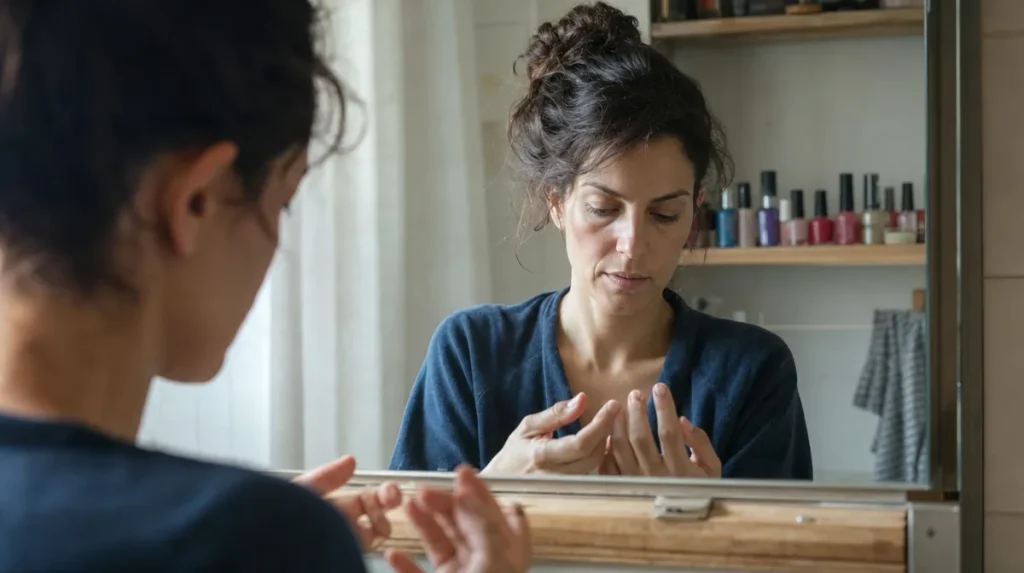
Nail polish is, chemically speaking, a thin plastic film. It needs two things that pull against each other: hardness, so it resists scuffing, and flexibility, so it does not crack when the nail underneath bends.
Think of house paint on a timber window frame. A frame expands and contracts with the weather. Paint that is too brittle cracks along those movement lines within a season. Nail plates behave the same way at a much smaller scale: they flex every time you type, open a jar or push a trolley.
A 2019 study in the International Journal of Cosmetic Science tracked wear patterns among 86 participants over seven days and found that most chipping began at the free edge and stress points, exactly where the nail flexes most, rather than across the centre of the nail. That pattern points to a formulation issue, not bad luck.
The practical upshot: a polish advertised as long-wearing is making a claim about its resin flexibility and pigment binding, not simply about how thick or shiny it looks in the bottle. You cannot see this quality by holding the bottle up to the light. You can only judge it by how the polish behaves after a few days of normal use, which is why specialists test wear over a full week, not a single afternoon.
Reading A Label Without A Chemistry Degree
Walk down any polish aisle and you will see numbers attached to the word free: three-free, five-free, occasionally ten-free. These describe which of a known group of resins, plasticisers and solvents, such as dibutyl phthalate, toluene and formaldehyde, have been left out of the formula.
DermNet, the dermatology reference founded by New Zealand specialists, publishes general guidance noting that formaldehyde and related resins in nail products have been linked to allergic contact dermatitis in a minority of users, particularly around the eyelids where the allergen can transfer from fingertip to face.
That guidance is useful for sensitive skin, but it says nothing about how long the polish will actually last on your nail. A ten-free formula can still chip in a day if the resin blend has poor adhesion or the pigment is milled too coarsely. The free-from number is a safety and sensitivity marker, not a durability score.
If you have a known sensitivity, the label is worth checking. If your main complaint is chipping, look instead at the brush, the coat thickness and your own prep routine, covered below.
Prepping The Nail Bed: The Step Everyone Skips
Most polish failure has nothing to do with the polish. It starts with what is already on the nail: natural oils, hand cream residue, or moisture left over from a recent shower.
Polish bonds to the nail plate through mechanical and chemical adhesion, similar to how wallpaper paste grips a wall best on a surface wiped clean of dust. Any oil film sits between the lacquer and the keratin, weakening that bond from the very first coat.
A simple self-test: after washing and drying your hands, wipe each nail once with a cotton pad dampened in rubbing alcohol or a dedicated nail prep solution, then press the pad against the nail for a second. If the pad still looks faintly oily or waxy, the nail was not ready for polish.
This single step, often skipped in a rush, explains a large share of the chipping that gets blamed on the product. Specialists assessing polish performance always standardise nail prep first, because an unprepared nail will make even a well-formulated lacquer look poor.
Brush Shape And Why It Changes Your Result
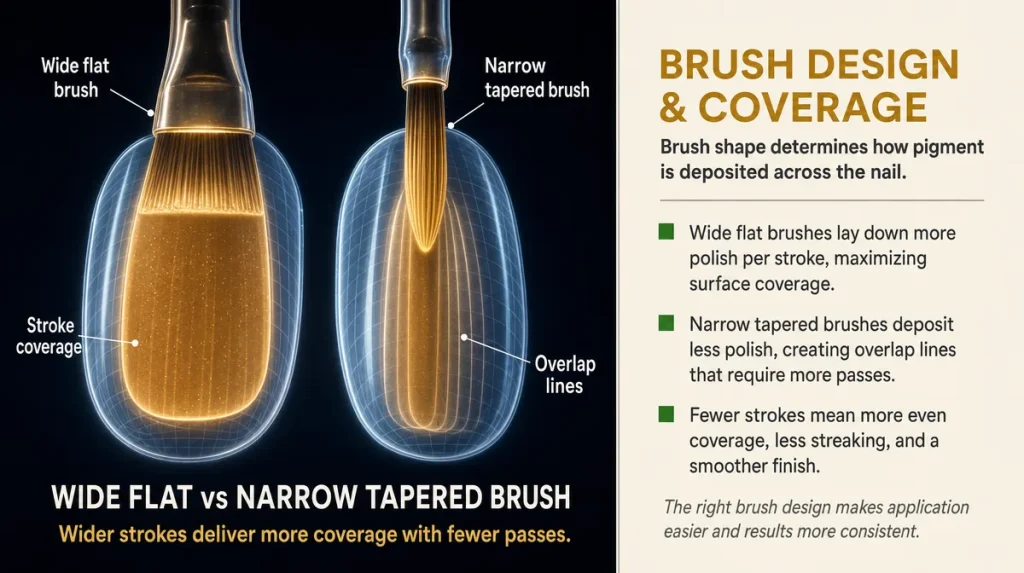
Pull the brush out of two different bottles and you will notice the bristles are not the same shape. Some splay into a wide, flat paddle. Others taper to a slim oval. This is not cosmetic. Brush shape determines how evenly pigment lays down in a single stroke.
A wide, flat brush, similar to a paint roller compared with a thin artist’s brush, covers more surface area per stroke and leaves fewer visible lines where coats overlap. A narrow or thin brush demands more strokes to cover the same nail, and each extra stroke is another chance to drag already-drying polish and create ridges.
Specialists judging polish for streak-free finish typically apply each colour using a standardised three-stroke technique: one down the centre, one down each side. If a formula still looks patchy after three strokes under that method, the issue usually sits with pigment concentration rather than your hand.
You can run a version of this test yourself. Apply one coat using exactly three strokes and look at the nail under a window, not a bathroom light. Patchiness under daylight is the most honest test a polish will get.
Thin Coats Versus Thick: The Physics Of Drying
Nail polish dries from the outside in. Solvents evaporate from the surface first, forming a skin while the layer underneath stays soft for far longer than it looks.
It behaves like custard left to cool: a film sets on top while the centre stays liquid. Touch that custard too soon and your finger leaves a crater. A thick coat of polish does exactly the same thing, and the dent you create at the ten-minute mark becomes a permanent feature of the finished manicure.
A 2021 formulation review published in a cosmetic science journal noted that two thin coats dry fully, right through the layer, in close to half the time it takes one thick coat to dry below the surface. Thin coats also chip less, because a thinner film flexes with the nail rather than cracking under it.
The habit worth building is patience between coats, not patience with the brush. Two deliberately thin layers, each left two to three minutes before the next, will outlast one generous layer almost every time, regardless of brand or price point.
Base Coat And Topcoat: What They Are Actually Doing
A base coat and a topcoat are not polish in a different colour. They are functional layers doing a specific mechanical job.
Base coat is designed to grip the nail plate on one side and the coloured lacquer on the other, acting as a kind of primer the way painters use one on bare plaster before a finish coat goes on. Skipping it does not just risk staining from deep pigments like red or dark green, it also removes the strongest adhesion layer in the whole system.
Topcoat’s job is different again: it seals the surface against scuffing and UV-driven colour fade. Ordinary air-dry topcoats cure through solvent evaporation and can take up to an hour to fully harden, during which a manicure remains vulnerable to dents from bedding or clothing. UV and LED gel topcoats cure through a chemical reaction triggered by light rather than by evaporation, which is why they harden within minutes rather than hours and generally outlast air-dry systems on wear tests.
Neither option is better in every case. Gel systems trade longer wear for a more involved removal process, covered in the final section below.
What Marketing Claims Actually Mean, And What They Don’t
Bottles carry phrases such as chip-resistant, salon finish and high shine with no regulatory definition behind any of them. Unlike sunscreen or medicine labels, there is no standard test a brand must pass before using these words.
Consumer NZ, the independent non-profit that has run comparative lab testing since 1959, has previously noted in its general product guidance that marketing language in the beauty category is rarely linked to a specific, disclosed test method. That does not mean every claim is false. It means the claim alone tells you nothing you can verify.
What can be verified, at home, is wear over time. Mark a manicure date somewhere you will see it, such as a phone note, and check back on day three, day five and day seven. A polish that still looks intact at day five under that simple tracking method is doing something right, regardless of what the label promised.
Glossy features in publications such as Fashion Quarterly or Viva often showcase seasonal colour trends rather than durability findings, which is a different and entirely reasonable editorial purpose. Trend coverage and performance testing answer different questions, and it helps to know which one you are reading.
Judging Results: How Long A Manicure Should Realistically Last
Expecting a regular lacquer manicure to survive two weeks without a single chip sets you up for disappointment. Independent wear observations, including the kind of general guidance Consumer NZ publishes on cosmetic durability, typically treat four to six days of visible wear on fingernails as a realistic benchmark for a well-applied two-coat lacquer manicure with topcoat, longer on toenails where friction and washing are less frequent.
Several factors shorten that window regardless of formula: frequent hand washing, hot water, dishwashing without gloves, and manual work such as gardening or typing on mechanical keyboards. None of these point to a faulty product. They are simply mechanical stress the film has to absorb.
Gel systems extend that benchmark to roughly two to three weeks for many wearers, a figure consistent with the longer cure and thicker film gel chemistry allows.
If a manicure is failing well short of these ranges, work back through prep, coat thickness and topcoat timing before assuming the polish itself is the problem. In most cases examined by specialists, the formula is rarely the first thing at fault.
Removal Without Damaging The Nail Plate
How a manicure comes off matters as much as how it goes on. Acetone dissolves the polish film efficiently but also strips natural oils from the nail plate and surrounding skin, which is why nails often look dull and feel dry immediately after removal.
Soaking a cotton pad in acetone and wrapping it in foil for five to ten minutes, rather than scraping or picking at polish, limits the mechanical stress on the nail surface. Picking or peeling, especially with gel systems, pulls away layers of the nail plate itself along with the colour, a process that can take weeks to grow out visibly.
DermNet’s published patient guidance on nail care notes that repeated peeling of gel or acrylic systems is a more common cause of thin, weak-feeling nails than the chemical exposure from acetone itself. Following removal with a hand cream containing an emollient such as glycerin or a plant oil may help restore surface moisture, though individual results vary.
A week without polish between manicures, where practical, gives the nail plate a chance to rehydrate before the next application.
Key Takeaways
- Chip resistance depends more on nail prep, coat thickness and brush technique than on brand or price.
- Free-from labels describe excluded ingredients and sensitivity risk, not how long a polish will wear.
- Two thin coats, applied with patience between layers, consistently outlast one thick coat.
- Marketing phrases like chip-resistant carry no standard test behind them; a simple day-by-day check at home tells you more.
- Four to six days of wear on fingernails is a realistic benchmark for lacquer; gel systems typically extend that to two to three weeks.
A Quick Checklist Before You Paint
- Wipe each nail with alcohol or prep solution and check the pad for residue before applying colour.
- Apply base coat on every manicure, especially under deep reds, greens and blues.
- Use three deliberate strokes per nail rather than multiple short dabs.
- Apply two thin coats rather than one thick one, leaving two to three minutes between them.
- Seal with topcoat and reapply it every two to three days if you want to extend wear.
- Remove with soaked, wrapped cotton rather than peeling, and moisturise the nail plate afterwards.
This article is general information and does not replace advice from a dermatologist or other qualified professional.
Individual results vary depending on nail condition, lifestyle and application technique.