
Holly Anderson, Beauty Editor.
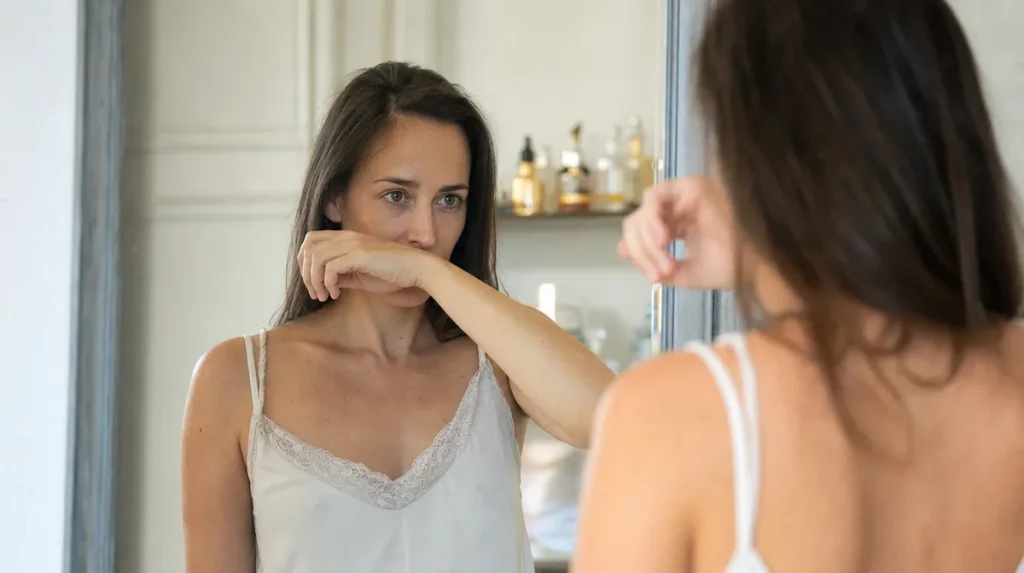
You’re standing at the bathroom mirror with your wrist raised for the third time in five minutes, trying to work out if the bottle you bought on Saturday still smells the way it did in the shop. It doesn’t, quite. The shelf behind you holds the evidence: half a dozen bottles, each worn twice and then abandoned, because the scent that seemed perfect at the counter turned into something else entirely by evening.
Here is the useful part first. A fragrance is not meant to smell the same at ten in the morning as it does at four in the afternoon. It is built, deliberately, in layers that unfold over hours. Once you understand how that works, and what specialists actually check before they judge a scent any good, you stop buying on first impression and start buying on how a fragrance behaves over a whole day.
- A fragrance needs at least twenty minutes on skin before you can judge it fairly, because the opening smell is only the alcohol and top notes, not the finished scent.
- Concentration labels like eau de parfum and eau de toilette describe strength, not skill, so the strongest-sounding bottle is not automatically the best made.
- Longevity and sillage depend heavily on your own skin’s oil level, which is why a scent can smell completely different on you than it did on a friend.
Reading Past The Concentration Percentage On The Label
Eau de parfum, eau de toilette, parfum: the words on the front of the bottle look like a hierarchy of quality but they only describe strength, not skill. These terms are not legally standardised the way food labelling is, so one house’s eau de parfum can sit at eighteen per cent fragrance oil while another’s sits at twelve.
Think of it the way you would think of a pot of tea. A stronger brew isn’t automatically a better one, it’s just steeped for longer or with more leaves. A well-made eau de toilette with a skilled blend can outperform a clumsy eau de parfum for hours, even though the label suggests otherwise.
The mistake most buyers make is assuming concentration equals quality and reaching for the strongest-sounding option by default. Fragrance chemists tend to check the note structure first, the percentage second. What matters is how the oils are balanced against each other, not the number printed under the name.
A quick way to judge this yourself: spray a small amount and note the time. If a fragrance marketed as eau de toilette is still detectable on your skin after six hours, the concentration label has told you very little. Judge the performance, not the printed word.
Why A Fragrance Changes Shape Over The Day
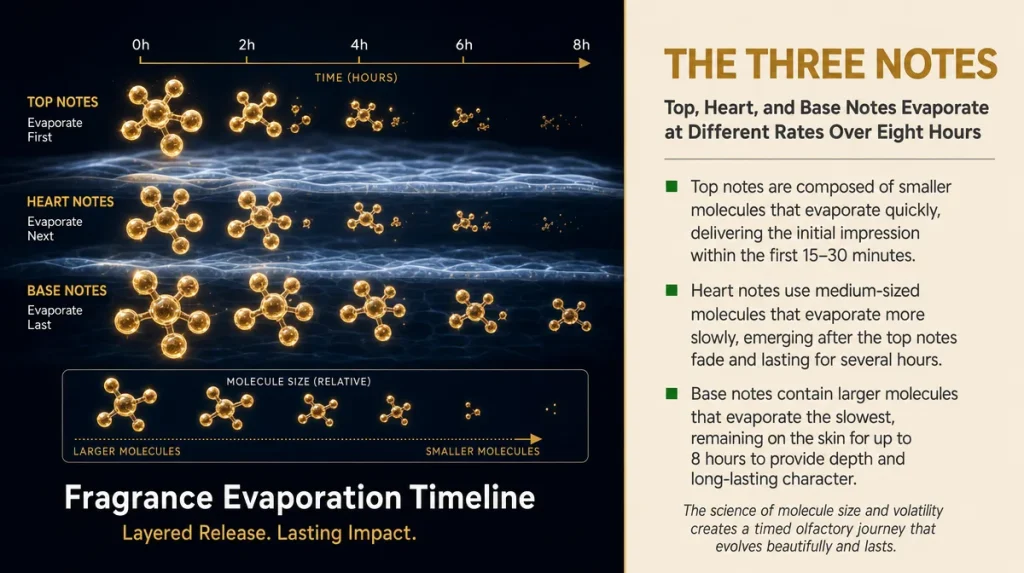
Every fragrance is built in three loose layers: top notes, heart notes and base notes. They don’t play at once, they take turns, because the molecules that make them up evaporate at different speeds.
Top notes are usually citrus or light green materials, small molecules that evaporate fast, often within the first fifteen to thirty minutes. Heart notes, frequently floral, are heavier and settle in for the next few hours. Base notes, things like woods, musks and resins, are the heaviest molecules and can still be present a full day later, quiet, low down, but there.
A 2019 study in Chemical Senses tracked how perceived fragrance intensity shifts across an eight-hour wear period and found that the notes people identify in the first five minutes rarely match what they identify at hour six, simply because the earlier, lighter materials have already left the skin.
The household version of this is a pot of soup on the stove. The first thing you smell when it starts cooking is not what the finished dish smells like an hour later. Both are true descriptions of the same pot, just at different moments.
The practical mistake is judging a fragrance entirely on that first spray, when you are only smelling the top note, the part of the scent designed to fade first.
The Twenty-minute Rule: Judging A Scent Properly
Spray once on clean skin, not on clothing and not on paper, then leave it alone. Do not sniff again for at least twenty minutes.
That waiting period matters because the alcohol carrier in every fragrance evaporates within the first minute or two, taking with it a sharp, slightly medicinal smell that has nothing to do with the finished scent. Judging a fragrance during that first minute is a little like judging a cake by tasting the raw batter.
After twenty minutes, smell your wrist from a short distance rather than pressing your nose directly against the skin, which can overwhelm your own sense of smell, a state perfumers call olfactory fatigue. Step away, do something else, then come back an hour later and smell it again.
A simple self-test: spray two fragrances you are deciding between, one on each wrist, and check them again at the twenty-minute mark, the two-hour mark and, if you can manage it, before bed. Most buyers only ever experience the first mark. The other two are where genuine differences in quality show up, in how gracefully a scent fades rather than how loudly it arrives.
Testing more than two or three fragrances in one sitting rarely works. After the third or fourth spray, your nose stops distinguishing between them accurately, which is why counters that let you test six scents in ten minutes are not doing you any favours.
Why The Same Bottle Smells Different On Two People
Skin is not a neutral surface. Its natural oil level, its pH and even the balance of bacteria living on it all interact with fragrance molecules before they reach your nose, which is why a scent that smells warm and rich on a friend can smell sharper or thinner on you.
Drier skin tends to hold fragrance for a shorter time because there is less natural oil for the heavier base note molecules to bind to. Oilier skin often extends wear time, sometimes considerably, because those molecules have something to cling to.
DermNet, the dermatology reference founded by New Zealand dermatologists, notes in its general skin barrier guidance that the skin’s natural lipid layer varies significantly between individuals, and even across the same person’s face and body, which helps explain why a fragrance applied to a wrist can behave differently to the same fragrance applied to the neck.
The mistake here is trusting someone else’s glowing description of a scent as if it will translate directly onto your own skin. It is useful information, but it isn’t a guarantee.
A practical adjustment: if you know your skin runs dry, look for a slightly heavier concentration or apply a thin, fragrance-free moisturiser to your pulse points first. The moisture gives base notes something to hold onto, which can meaningfully extend how long a scent lasts without changing its character.
Judging Longevity And Sillage Without Guessing
Sillage, the trail a fragrance leaves in the air around you, and longevity, how long it lasts on skin, are two different qualities and worth testing separately.
Pulse points, the wrists, the base of the throat, behind the ears, run slightly warmer than the rest of the body, and that warmth helps fragrance evaporate steadily throughout the day rather than in one early burst. Spraying onto clothing instead can make a scent last considerably longer, sometimes into the next day, because fabric fibres hold onto fragrance oils more readily than skin does. Worth knowing if you want a scent to last through a long event, and worth avoiding if strong fragrance tends to feel overwhelming by evening.
To judge sillage honestly, ask someone else. Have a friend or partner tell you at arm’s length, at midday and again in the evening, whether they can still smell it. Your own nose adapts to a scent you are wearing within twenty minutes or so and effectively stops registering it, a normal process and not a sign the fragrance has faded.
The common mistake is reapplying because you can no longer smell your own perfume. Often it is still very much present to everyone else in the room. If you want to check properly, step outside for ten minutes and let your nose reset before smelling your wrist again.
What Matters Versus What Is Marketing
Packaging, celebrity names and the poetic list of notes printed on the box are the parts of a fragrance built to sell it, not necessarily to describe it accurately. The notes listed on packaging are often an approximation chosen for evocative appeal, sometimes decided by a marketing team well after the actual formula was finished by a perfumer.
Consumer NZ, which has run independent product testing since 1959, has pointed out in its general guidance on cosmetics and personal care marketing that descriptive claims on packaging are not independently verified before sale, a point that applies just as much to fragrance as to skincare.
What tends to matter more, according to fragrance chemists who study formulation, is the quality and proportion of the actual materials used, something no amount of bottle design or celebrity endorsement can substitute for. A beautifully designed bottle holding a poorly balanced formula will still smell poorly balanced.
A reasonably reliable shortcut: judge a fragrance by how it performs over several hours of actual wear rather than by the story printed on the box or the name attached to it. If a scent still smells coherent and pleasant at hour four, with no single note fighting for attention over the others, the formula behind it is probably a competent one, regardless of who is on the bottle.
Storing A Fragrance So It Does Not Turn
Fragrance oils degrade over time, and heat, light and air all speed the process along, in much the same way a bottle of wine left on a sunny windowsill turns faster than one kept in a dark cupboard.
Bathrooms, for all their convenience, are usually the worst place to keep a fragrance. The steam from showers introduces heat and humidity cycles that accelerate the breakdown of certain aromatic compounds, particularly citrus and light green top notes, which are the most fragile molecules in any formula.
A fragrance kept in a cool, dark drawer or cupboard, away from direct sunlight and temperature swings, can reasonably be expected to perform well for several years. One left on a sun-facing windowsill may noticeably change character within months, developing a flatter, slightly sour edge where the top notes used to be.
A simple test if you suspect a bottle has turned: compare the first ten minutes of wear against your memory of how it smelled when new. A noticeably sharper, almost vinegary opening, where there used to be citrus or florals, is a reasonably reliable sign the oils have started to oxidise. It is not unsafe to wear, but it will not perform the way it did originally, and no amount of extra spraying will fix a formula that has already changed.
Building A Testing Routine Before You Buy
Treat a new fragrance the way you would treat a significant purchase, because for most people it is one. Test on skin, not paper, since paper cannot replicate the warmth and oil that shape how a scent actually develops. Test only two or three scents in one visit, since your nose loses the ability to distinguish clearly after that. Wait the full twenty minutes before forming a real opinion, then check again several hours later.
If a counter will not let you leave with a sample, ask whether a small sample vial is available. New Zealand Woman’s Weekly and Fashion Quarterly have both, in reader advice columns over the years, suggested wearing a sample fragrance for a full day before committing to a full bottle, a habit worth borrowing regardless of where you first read it.
Keep a simple note, even just on your phone, of what a fragrance smelled like at twenty minutes, at two hours and by evening. Memory is unreliable after a week of other scents have crossed your path, and a short note settles arguments with yourself later at the counter.
The goal is not to become suspicious of every bottle on the shelf. It is to give a fragrance the same few minutes of patience a chemist would give it before deciding whether it deserves a place in your cabinet.
Key Takeaways
- A fragrance is designed to change over hours, so judge it at twenty minutes, at two hours and again by evening, not on the first spray.
- Concentration labels such as eau de parfum and eau de toilette describe strength, not craftsmanship. A well-balanced formula at a lower concentration can outperform a poorly balanced one at a higher concentration.
- Your own skin’s oil level shapes how long a scent lasts and how it reads to others, which is why a friend’s glowing review does not always translate.
- Sillage and longevity are separate qualities. Test them separately, and ask someone else what they can smell rather than relying only on your own nose, which adapts quickly.
- Store fragrance away from heat, light and humidity. Bathrooms are convenient but tend to shorten a bottle’s useful life.
A Short Checklist Before You Buy
- Spray on skin, never on paper, and wait a full twenty minutes before forming an opinion.
- Limit yourself to two or three fragrances per visit so your nose stays reliable.
- Check the scent again after several hours, ideally by evening, before deciding.
- Ask a friend or partner to judge sillage at a distance rather than trusting your own adapted sense of smell.
- Store any fragrance you buy in a cool, dark place away from direct sunlight and bathroom steam.
This article is general information and does not replace advice from a qualified professional.
Individual experience with any fragrance may vary depending on skin type and personal chemistry.